How Mini Desktop Computers Are Quietly Changing the Way We Work
As an Amazon Associate, I earn from qualifying purchases.
There’s something almost philosophical about a computer that fits in your palm. For decades, the desktop PC was defined by its bulk, tower cases the size of filing cabinets, tangled webs of cables, and a footprint that claimed an entire corner of the room as its own. Then, quietly, something changed. Engineers started asking a different question: not “how powerful can we make this?” but “how small?” The result is the mini desktop computer, a category of machine that has gone from curiosity to cornerstone in a surprisingly short span of time.
The story of mini desktops really begins to pick up momentum in the early 2010s, when Intel introduced its Next Unit of Computing, better known as the NUC. The concept was almost absurdly simple: take the guts of a capable laptop, strip away the screen and battery, and pack what remains into a box roughly the size of a thick paperback novel. Enthusiasts were intrigued. Businesses took notice. And a market was born.
Since then, the category has exploded. Companies like ASUS, Beelink, Minisforum, Apple, and countless others have flooded the space with machines that range from humble media players to workstation-class powerhouses. The form factor has diversified too. Some mini desktops are stubby little cubes. Others are long, flat “stick” computers that plug directly into an HDMI port. Apple’s Mac Mini sits at the elegant end of the spectrum, a sleek aluminum slab that almost doesn’t look like a computer at all. The Raspberry Pi, while a different beast entirely, has introduced an entire generation of hobbyists and students to the idea that serious computing doesn’t require serious size.
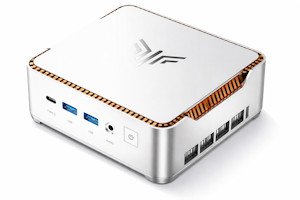
What’s driving this miniaturization? The answer is a confluence of forces that have been building for years. Mobile processors have become extraordinarily efficient, delivering performance that would have seemed impossible in such small thermal envelopes even a decade ago. Apple’s transition to its own silicon, the M-series chips, demonstrated to the entire industry just how much performance could be wrung from a tightly integrated, power-conscious design. Suddenly, a computer the size of a Mac Mini could outperform machines that were physically ten times its size. Competitors scrambled to respond.
At the same time, the nature of how most people actually use computers has shifted. Streaming has replaced local media libraries for many users. Cloud storage has reduced the demand for enormous local drives. Web applications handle tasks that once required heavy software installations. For a substantial portion of the population, the raw horsepower of a full tower is simply overkill, and a well-specced mini desktop handles everything they need without breaking a sweat, or a budget.
The practical appeal of these machines is hard to overstate. In an era when urban apartments come at a premium and open-plan offices are the norm, physical space is genuinely valuable. A mini desktop can perch behind a monitor on a VESA mount, turning the display itself into the apparent source of computing power. It can live on a shelf, in a drawer, or tucked discreetly into an entertainment center. For businesses deploying dozens or hundreds of machines, the logistics become dramatically simpler, and the energy savings add up to something meaningful over time.
Home theater enthusiasts have embraced the form factor with particular enthusiasm. A mini PC running a media center application can replace a dedicated streaming device, a Blu-ray player, and a gaming console simultaneously, all while consuming a fraction of the power of a traditional desktop. The living room setup that once required a dedicated cabinet now fits in a single small box tucked behind the television.
There are tradeoffs, of course. Mini desktops are not for everyone, and they ask their owners to accept certain limitations. Upgradeability is often constrained or nonexistent. Many models solder RAM directly to the board and offer only one or two storage slots. Thermal management is a perpetual engineering challenge; pushing high-end components into a small chassis generates heat that has nowhere to go, which is why sustained workloads can sometimes cause these machines to throttle their performance. Connectivity, while generally solid, rarely matches what a full tower can offer in terms of expansion slots and ports.
For power users who run GPU-intensive workloads, 3D rendering, machine learning, video editing at the highest levels, the mini desktop still struggles to compete with larger machines that can accommodate dedicated graphics cards. The laws of physics haven’t been repealed. A desktop GPU is still larger than the entire chassis of many mini PCs, and no amount of engineering cleverness has yet solved that particular equation.
But for the vast and growing middle ground of users, including professionals, students, home users, small business owners, the mini desktop has become one of the most sensible computing choices available. The price-to-performance ratio in this category has never been better, and the competition among manufacturers has driven rapid iteration. Machines that were considered high-end two years ago are now available at entry-level prices.
There’s also something genuinely delightful about these small computers that transcends pure utility. They invite experimentation. A mini PC is easy to move, easy to repurpose, and somehow less intimidating than a full workstation. People build home servers with them, set them up as dedicated gaming machines, use them to learn programming or network administration. The low cost of entry means that buying one to try something new doesn’t feel like a major commitment.
In this way, the mini desktop is doing something its larger predecessors rarely managed: making computing feel accessible and even a little playful. The trajectory of the category points only in one direction. As chipmakers continue to push the boundaries of efficiency, as software becomes better optimized for compact hardware, and as users grow more comfortable leaving heavy computing to the cloud, the argument for a large desktop becomes narrower with every passing year. That doesn’t mean tower PCs are going anywhere. There will always be a market for maximum expandability and maximum power. But the center of gravity in personal computing is shifting, and the mini desktop is a significant reason why. The machine that fits in your palm, it turns out, is more than enough. For most of us, it has been for a while. We’re only now starting to act like we believe it.
Leave a Reply