Two Roads. One Great Camera.
Choosing a camera in 2026 feels a bit like standing at a crossroads. On one side, you have the high-tech, AI-driven world of mirrorless: on the other, the rugged, dependable, and deeply tactile world of the DSLR. Canon has placed its biggest bets on the former, but the latter refuses to quietly retire and understanding why tells you a lot about where photography is headed.
The Mirrorless Revolution
Canon’s EOS R system has matured into one of the most capable mirrorless ecosystems on the market. By ditching the internal mirror in favor of a digital feed, these cameras shed weight while gaining something almost uncanny: autofocus systems powered by neural networks that can lock onto a bird’s eye or a racing car’s tire with a precision that feels less like technology and more like witchcraft.
At the very top sits the EOS R1, Canon’s flagship sports and news machine. Built around a stacked sensor and some of the most robust weather-sealing the company has ever offered, it is the camera you reach for when nothing can go wrong. Just below it is the R5 Mark II, a 45-megapixel, 8K-capable body that has become the default choice for wedding photographers, landscape artists, and high-end videographers who need resolution to spare.
For photographers who want professional results without the $4,000-plus price tag, the R6 Mark III has emerged as the lineup’s most compelling argument. Its 32.5-megapixel full-frame sensor pairs with professional-grade video features in a body that feels genuinely balanced. It’s not a compromise, but a considered design choice.
Then there are the APS-C options, the R7 and R10, which deserve more credit than they typically get. The crop sensor on these cameras effectively extends the reach of any lens attached to them, making them ideal for wildlife and sports shooters who need a longer effective focal length. The R7 leads with top-tier speed, while the R10 offers a compact, budget-friendly entry point that still inherits the fast autofocus of its more expensive siblings.
The DSLR’s Quiet Persistence
Canon hasn’t released a new DSLR body in several years, and yet the category refuses to disappear. The reason is partly practical and partly philosophical. On the practical side, DSLR batteries last for days in a way that mirrorless bodies simply cannot match. On the philosophical side, an optical viewfinder gives you an unmediated window into the scene in front of you. It’s not a digital approximation of it, but actual light, passing through glass directly to your eye.
The EOS 90D remains the most versatile of the surviving DSLR lineup, pairing a high-resolution 32.5-megapixel sensor with ergonomics that feel immediately intuitive to anyone who has spent time with a Canon body. At the professional extreme, the EOS-1D X Mark III is virtually indestructible, and professionals who grew up shooting sports with a DSLR continue to reach for it, drawn by the mechanical satisfaction of the shutter and the zero-lag clarity of the optical view. For beginners, the Rebel SL3 makes a surprisingly strong case for itself as the smallest DSLR available, simple, light, and far more tactile than any smartphone.
What’s Shifting in 2026
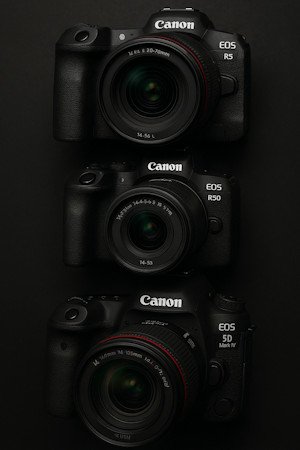
Two trends are reshaping the Canon lineup this year. The first is deeper AI integration: modern EOS R cameras now use neural network processing not just for autofocus, but to upscale images in-camera and even anticipate subject movement before it happens. The second is a push toward content creators, exemplified by the “V” series of video-centric bodies like the R50 V, which adds improved microphones and better thermal management for extended recording sessions.
Perhaps the most intriguing development, though, is still a rumor. There is significant buzz around a retro-inspired Canon body, possibly called the RE-1, designed to evoke the classic AE-1 film cameras of the 1970s while running entirely modern internals. Whether it arrives or not, the fact that Canon is reportedly considering it says something interesting about where consumer appetite is right now.
So, Which Do You Choose?
The mirrorless EOS R system is the right choice if you want the best autofocus available, access to Canon’s growing RF lens catalog, and the confidence of seeing exactly what your sensor sees before you press the shutter. The DSLR is the right choice if the clarity of an optical viewfinder matters to you, if you want to stretch a budget further on the used market, or if you simply prefer a camera that doesn’t rely on a screen to show you the world. Neither answer is wrong. They just take you to very different places.