Basic Photography – Take Better Landscape Photos
This session focuses on improving landscape photography skills, drawing inspiration from the Landscapes chapter of the book Tell Your Story with Light. It explores how composition, light, and visual storytelling can be used to create more engaging and expressive landscape images.
Photography
Canon in 2026
Two Roads. One Great Camera.
Choosing a camera in 2026 feels a bit like standing at a crossroads. On one side, you have the high-tech, AI-driven world of mirrorless: on the other, the rugged, dependable, and deeply tactile world of the DSLR. Canon has placed its biggest bets on the former, but the latter refuses to quietly retire and understanding why tells you a lot about where photography is headed.
The Mirrorless Revolution
Canon’s EOS R system has matured into one of the most capable mirrorless ecosystems on the market. By ditching the internal mirror in favor of a digital feed, these cameras shed weight while gaining something almost uncanny: autofocus systems powered by neural networks that can lock onto a bird’s eye or a racing car’s tire with a precision that feels less like technology and more like witchcraft.
At the very top sits the EOS R1, Canon’s flagship sports and news machine. Built around a stacked sensor and some of the most robust weather-sealing the company has ever offered, it is the camera you reach for when nothing can go wrong. Just below it is the R5 Mark II, a 45-megapixel, 8K-capable body that has become the default choice for wedding photographers, landscape artists, and high-end videographers who need resolution to spare.
For photographers who want professional results without the $4,000-plus price tag, the R6 Mark III has emerged as the lineup’s most compelling argument. Its 32.5-megapixel full-frame sensor pairs with professional-grade video features in a body that feels genuinely balanced. It’s not a compromise, but a considered design choice.
Then there are the APS-C options, the R7 and R10, which deserve more credit than they typically get. The crop sensor on these cameras effectively extends the reach of any lens attached to them, making them ideal for wildlife and sports shooters who need a longer effective focal length. The R7 leads with top-tier speed, while the R10 offers a compact, budget-friendly entry point that still inherits the fast autofocus of its more expensive siblings.
The DSLR’s Quiet Persistence
Canon hasn’t released a new DSLR body in several years, and yet the category refuses to disappear. The reason is partly practical and partly philosophical. On the practical side, DSLR batteries last for days in a way that mirrorless bodies simply cannot match. On the philosophical side, an optical viewfinder gives you an unmediated window into the scene in front of you. It’s not a digital approximation of it, but actual light, passing through glass directly to your eye.
The EOS 90D remains the most versatile of the surviving DSLR lineup, pairing a high-resolution 32.5-megapixel sensor with ergonomics that feel immediately intuitive to anyone who has spent time with a Canon body. At the professional extreme, the EOS-1D X Mark III is virtually indestructible, and professionals who grew up shooting sports with a DSLR continue to reach for it, drawn by the mechanical satisfaction of the shutter and the zero-lag clarity of the optical view. For beginners, the Rebel SL3 makes a surprisingly strong case for itself as the smallest DSLR available, simple, light, and far more tactile than any smartphone.
What’s Shifting in 2026
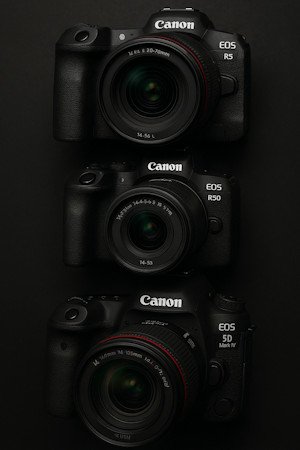
Two trends are reshaping the Canon lineup this year. The first is deeper AI integration: modern EOS R cameras now use neural network processing not just for autofocus, but to upscale images in-camera and even anticipate subject movement before it happens. The second is a push toward content creators, exemplified by the “V” series of video-centric bodies like the R50 V, which adds improved microphones and better thermal management for extended recording sessions.
Perhaps the most intriguing development, though, is still a rumor. There is significant buzz around a retro-inspired Canon body, possibly called the RE-1, designed to evoke the classic AE-1 film cameras of the 1970s while running entirely modern internals. Whether it arrives or not, the fact that Canon is reportedly considering it says something interesting about where consumer appetite is right now.
So, Which Do You Choose?
The mirrorless EOS R system is the right choice if you want the best autofocus available, access to Canon’s growing RF lens catalog, and the confidence of seeing exactly what your sensor sees before you press the shutter. The DSLR is the right choice if the clarity of an optical viewfinder matters to you, if you want to stretch a budget further on the used market, or if you simply prefer a camera that doesn’t rely on a screen to show you the world. Neither answer is wrong. They just take you to very different places.
Build Your First Camera Bag on Any Budget
Putting together your first camera bag can feel intimidating. There’s an endless stream of gear videos, product reviews, and “must-have” lists that make it seem like you need thousands of dollars just to get started. The truth is much simpler: your camera bag should carry only what helps you make better photos. Nothing more. Whether you’re shooting with a smartphone, a beginner DSLR, or a mirrorless setup, the goal isn’t to own everything. It’s to build a small, flexible kit that grows naturally as your skills and interests develop.
Start With the Bag You Already Own
Your camera bag doesn’t need to be fancy or expensive. In fact, for many beginners, the best camera bag is the backpack already sitting in the closet. A simple padded insert can turn almost any bag into a perfectly functional camera carrier. Sling bags and compact shoulder bags also work well if you’re only carrying one camera and a lens or two.
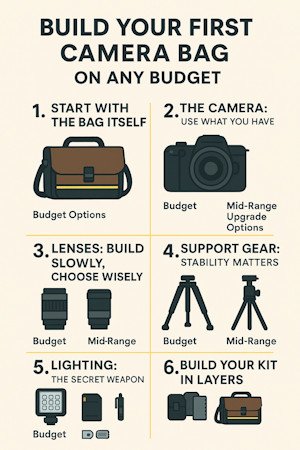
As you shoot more, you’ll start to notice what works and what doesn’t. Maybe you want faster access to your camera, better weight distribution for long walks, or extra space for a laptop and tripod. That’s when upgrading to a dedicated camera backpack or sling can make sense. The right bag depends entirely on your shooting style. Street photographers tend to prefer slings for quick access, while hikers and travelers often lean toward backpacks for comfort and balance.
The Camera: Use What You Have
Your camera is the heart of your kit, but it doesn’t have to be expensive to be effective. Modern smartphones can produce incredible images, especially when paired with a small clamp tripod for stability. If you’re ready to step up, a used entry-level DSLR or mirrorless camera can be an excellent and affordable gateway into interchangeable lenses and full manual control. If you later decide to upgrade, current-generation APS-C mirrorless cameras offer outstanding quality, speed, and portability. Compact full-frame bodies can give you even more creative flexibility, but they’re far from necessary when you’re starting out. One of the smartest principles to follow is this: spend more on lenses than on camera bodies. Camera models change every few years, but good lenses can last decades.
Lenses: Let Them Shape How You See
It’s tempting to want a bag full of lenses, but more gear doesn’t automatically mean better photos. In fact, starting with just one or two lenses often leads to stronger skills and better results. Most photographers begin with the standard kit lens that comes with their camera, usually something like an 18–55mm or 16–50mm zoom. These lenses are far more capable than they’re given credit for. Adding an inexpensive 50mm f/1.8, often called the “nifty fifty”, opens the door to beautiful portraits, low-light photography, and creative background blur.As your interests become clearer, you may find yourself drawn to wider lenses for landscapes, telephoto zooms for wildlife or sports, or fast primes for artistic depth of field. But there’s no rush. Many photographers discover that a single prime lens teaches them more about composition, framing, and movement than a whole bag of zooms.
Stability Changes Everything
Sharp photos depend heavily on stability. Even the best camera struggles when your hands can’t hold still, especially in low light. A small tabletop tripod or affordable aluminum tripod can immediately improve sharpness, while a smartphone clamp opens up new possibilities for mobile shooting. If you do a lot of travel, hiking, or video work, a compact travel tripod or carbon-fiber model becomes worth considering. Video shooters may also benefit from small gimbals, which add smooth, cinematic movement. But even a simple, budget tripod can dramatically expand what you’re able to shoot.
Lighting: The Most Powerful Upgrade You Can Make
If there’s one upgrade that consistently transforms photography, it’s lighting. A tiny clip-on LED or small on-camera light can instantly improve portraits, product shots, and video quality. Reflectors, which cost very little, can shape natural light in beautiful ways. As your skills grow, adding a portable flash, wireless triggers, and simple softboxes or umbrellas gives you complete control over light, opening creative doors that no camera upgrade alone can match. Learning light changes everything.
The Small Essentials That Matter Most
Some of the most important items in your camera bag are also the cheapest. Extra batteries and memory cards prevent missed moments. A microfiber cloth keeps lenses clean. A rain cover or even a simple plastic bag can save your gear in bad weather. A power bank keeps everything running, and a small notebook can capture shot ideas, lighting setups, or location notes. These little details make the difference between frustration and smooth shooting.
Let Your Kit Grow Naturally
Think of your camera bag as something that evolves over time. At first, all you really need is a camera, one lens, a cleaning cloth, and a spare battery. From there, you might add a tripod, a small light, or a second lens. Eventually, your setup may expand into better bags, advanced lighting, and specialty lenses, but only when your photography demands it. Every piece of gear you add should solve a real problem or unlock a new creative possibility. If it doesn’t, it probably doesn’t belong in your bag.
Enjoy!
A great camera bag isn’t about owning the most equipment. It’s about having the right tools for the images you want to create. Start small. Upgrade slowly. Let your curiosity and creativity guide your choices. Over time, your bag will become a reflection of your unique photographic style, and every piece inside it will earn its place.
Nikon FX and DX Camera Formats
By techvideos.net/. For DSLR cameras, the format refers to the size of the camera image sensor. Nikon\’s future for both FX and DX camera systems is firmly centered on the Z-mount mirrorless platform, with DSLRs effectively phased out. However, there are still a lot of DSLR models around. Here is a breakdown of what to expect for each format.
It seems that Nikon is fully committed to both formats within the Z-mount system, but only in mirrorless cameras. FX is the future-proofed, performance-leading platform, while DX is the accessible, agile, and cost-effective gateway. Both will continue to evolve, but with FX receiving the lion\’s share of groundbreaking technology and lens development.
The following video explains the differences between the Nikon FX and DX DSLR camera systems.
Getting Hooked on Photography
I don’t remember when or how I first got hooked on photography. I know my first camera was a Kodak Instamatic 126. 126 referred to the size of the film which was in a plastic cartridge.
One day I was walking in town and passed a store window with some interesting objects on display. The store was a family run optician practice. Those gadgets had dials and what looked like a lens. I thought they could be a type of camera I’d never seen. I couldn’t quite decide what I was looking at. I had to know more.
I walked into the shop and spoke with an old guy who probably owned the place. He explained that those gadgets were 35mm SLR cameras. To me they seemed to be a type of device sent from another planet.
He explained how they worked but I didn\’t understand much of what he was saying or what it had to do with taking pictures. He showed me a Japanese Ricoh and a German Leica. They had a weight to them and a metallic feel.
There were orange and white numbers marked on a large lens barrel and a small housing at the top. Looking down through the lens I could see it was amazingly complex with many components hiding down there.
He explained that the lens was composed of 6 high quality glass elements that were organized into groups. The groups functioned to manipulate light rays of various properties to all come to focus at one place. Impressive!
Then he showed me where the flash would attach, where the camera body attached to a tripod and how the lens could be removed and changed for other lenses with other optical capabilities.
Then he showed me the price tags. Being a small business, I understand now that to make money he had to charge close to full retail. I couldn\’t imagine how to justify paying that much for a camera. My Instamatic had cost less than $25.
I read magazines such as Modern Photography and Popular Photography to find out everything I could about those 35mm cameras.
I had to get myself a 35mm camera. All those SLRs were way too expensive for my budget. Eventually, I compromised with the purchase of a Konica 35mm rangefinder with an F1.8 lens. It wasn’t a Leica, but to me Konica represented a quantum improvement in photographic capability.