• Skip to primary navigation
  • Skip to main content
  • Skip to primary sidebar
  • Home
  • Login
  • Registration
  • Contact Us
  • Privacy Policy
  • Premium Hosting
  • Affiliate Disclosure

techvideos.net

  • Tech News
    • Personal Tech
    • WIRED Gear
    • TechRadar
  • Our Videos
    • Animation
    • Film Camera
    • Home Tech Videos
    • PC Builder Videos
    • Photography Videos
  • Tech at Amazon.com
  • Jackery Green Energy
  • B & H Photo
    • Webcams at B&H
    • Gaming Desktops at B&H

Personal Tech Today

The Television Market in 2026

by Leave a Comment

The television market in 2026 has reached a fascinating tipping point. Technologies that were the exclusive playground of “home theater enthusiasts” just two years ago have trickled down into the mid-range and budget segments.

​As an Amazon Associate, techvideos.net/ earns from qualifying purchases.

Here are the most significant developments in TV technology that are now accessible to budget-minded buyers.

​1. The Rise of “Budget” Mini-LED

​Until recently, Mini-LED was a premium feature reserved for flagship models. By 2026, it has become the standard for high-performance budget TVs.

​The Tech: Instead of a few dozen large light bulbs behind the screen, Mini-LED uses thousands of microscopic LEDs. This allows for much more precise Local Dimming, giving you “inky” blacks that rival OLED without the high price tag.

​Budget Access: Brands like TCL (QM6K series) and Hisense (U7/U8 series) are now offering Mini-LED panels for under $600. Even entry-level models are hitting brightness levels (up to 1,500 to 2,000 nits) that were unheard of in this price bracket previously.

​2. High-Frame Rate Gaming for All

​Gaming features used to be a major “tax” on a TV’s price. Now, the gap between a high-end gaming monitor and a budget TV has almost disappeared.

​144Hz Refresh Rates: While 120Hz was the gold standard, budget models like the TCL QM6K now offer 144Hz native refresh rates out of the box.

​HDMI 2.1 is Standard: Features like VRR (Variable Refresh Rate) and ALLM (Auto Low Latency Mode), which prevent screen tearing and lag on PS5/Xbox Series X, are now found on TVs costing less than $500.

​3. The “Affordable” OLED

​OLED has long been the “holy grail” of TV tech, but price has always been the barrier. In 2026, we are seeing the emergence of true “budget OLEDs.”

​LG B5 Series: The LG B-series has matured into a powerhouse for value seekers. You can now often find 48-inch or 55-inch OLEDs on sale for $650 to $800, offering the perfect contrast and “pixel-perfect” blacks once reserved for $2,000+ displays.

​Supply Chain Wins: Manufacturing costs for OLED panels dropped significantly in late 2025, allowing manufacturers to move away from the expensive “Evo” panels in their base models while still maintaining elite picture quality.

​4. AI-Powered Upscaling in Cheap Chips

​Previously, only expensive TVs from Sony or Samsung had the “brains” to make old 1080p content look like 4K.

​Generative AI Upscaling: Budget processors (like the Alpha 8 AI Gen2) now use sophisticated AI neural networks to “fill in the blanks” of low-resolution video. This means your old DVDs or standard-definition cable looks significantly sharper on a $400 TV today than it did on a $400 TV from 2022.

If you’re shopping right now, look for “Clearance” 2025 models (like the LG C5 or Samsung S90D). With the release of 2026 flagships at CES, these high-end “last year” models often drop into the budget-buyer territory ($800 to $950 range).
Filed Under: Personal Tech Today

The Future of Wellness

by Leave a Comment

How “Preventive” Health Wearables Are Changing the Game

​For years, our smartwatches and fitness trackers have diligently counted our steps, monitored our heart rates during workouts, and even gently nudged us to stand up every hour. But in 2026, the era of merely tracking health metrics is giving way to a more profound and proactive approach: preventive health wearables. These aren’t just gadgets that log data; they’re intelligent companions designed to anticipate potential health issues, optimize our well-being, and empower us to take action before problems arise.  ​The shift is monumental. We’re moving from a reactive healthcare model, addressing sickness once it manifests, to a truly preventive one, where technology acts as an early warning system and a personalized wellness coach.

​Beyond Steps: The Era of Metabolic Monitoring

​One of the most significant breakthroughs in preventive health wearables is the integration of continuous glucose and metabolic tracking for the general population. Historically, such monitoring was primarily for individuals managing diabetes. Today, non-diabetics are embracing these devices to unlock new insights into their body’s unique response to food, exercise, and stress.  ​Imagine knowing precisely how a specific meal affects your blood sugar levels and subsequent energy dips, or understanding which types of workouts optimize your fat burning. This real-time, personalized feedback allows individuals to fine-tune their diet and activity, leading to sustained energy, improved mood, and a reduced risk of developing metabolic disorders later in life. It’s about optimizing performance and longevity, not just treating illness.

​The Rise of the Ring: Screen-Free Health Management

​While smartwatches still hold their place, the discreet elegance and advanced sensor capabilities of smart rings have propelled them to the forefront of screen-free health tracking. Brands like Oura and the rapidly expanding offerings from tech giants like Samsung have made smart rings the go-to choice for comprehensive, unobtrusive monitoring.  ​These rings are masters of subtlety, seamlessly collecting data on sleep quality, heart rate variability (HRV), body temperature, and even stress recovery. The focus here is less on daily activity logs and more on deeper physiological insights, particularly around mental health and stress resilience. By understanding our body’s recovery patterns, these rings can provide personalized recommendations for rest, mindfulness, or gentle activity, helping users prevent burnout and maintain emotional balance in an increasingly demanding world.  

​The Mirror That Sees More: Biometrics for Mental Well-being

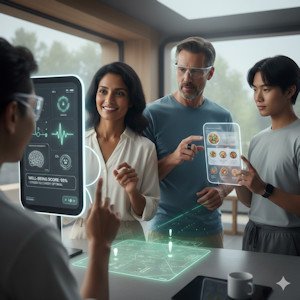
​Stepping beyond wrist and finger, the smart mirror is emerging as an unexpected but powerful tool in preventive health. These aren’t just mirrors that show you the weather; they’re sophisticated devices equipped with biometric sensors that can detect subtle changes in facial cues, skin tone, and even heart rate through advanced computer vision.  ​The most compelling application? Detecting early signs of burnout or chronic stress. Imagine a mirror that, during your morning routine, gently alerts you to elevated stress markers, suggesting a few minutes of guided meditation or a lighter schedule for the day. These mirrors act as silent guardians, providing a non-invasive way to monitor mental well-being and encourage proactive self-care, helping individuals intervene before stress escalates into more serious conditions.

​The Promise of Prevention

​The revolution in preventive health wearables is far more than a technological upgrade; it’s a paradigm shift in how we approach personal well-being. By equipping us with continuous, personalized data and actionable insights, these devices empower us to become active participants in our own health journey. They are moving us closer to a future where we don’t just react to illness, but actively cultivate a life of vitality, resilience, and sustained well-being.

​What’s next? Expect even more integration with AI coaching, personalized nutrition plans delivered directly to your fridge, and perhaps even microscopic sensors that provide real-time blood analysis. The era of preventive health is just beginning, and our future selves will undoubtedly be healthier for it.

Filed Under: Personal Tech Today

Unplugging on Purpose

by Leave a Comment

Why Some Young People Are Ditching Smartphones for Flip Phones and MP3 Players

For more than a decade, the smartphone has been treated as an unavoidable fact of modern life. It’s alarm clock, camera, entertainment system, social connector, wallet, and navigation tool all rolled into one glowing rectangle.

But a surprising counter-trend is quietly gaining momentum.

Across the U.S. and Europe, a growing number of teenagers and young adults are deliberately stepping away from smartphones, choosing instead to carry flip phones, MP3 players, and even standalone digital cameras. What looks at first like nostalgia or irony is, for many, a deeply intentional decision. One rooted in mental health, attention control, and a desire for calmer lives.

And unlike earlier “digital detox” movements, this one isn’t about taking breaks. It’s about changing daily habits entirely.

Digital Burnout Is Driving the Shift

Ask young people why they’re giving up smartphones, and the answer is rarely “because it’s cool.” Instead, they talk about exhaustion. Overstimulation. Anxiety. The constant pressure to stay connected.

Surveys show that nearly 70% of Gen Z adults consider themselves addicted to their digital devices, and many describe feeling trapped by endless notifications, algorithm-driven feeds, and social pressure to always be available. (See InsightTrendsWorld.)

For some, switching to a simpler phone is the only way to break the habit.

A 19-year-old interviewed by Yahoo Life described regularly spending ten hours a day on social apps before he boxed up his smartphone and replaced it with a flip phone and MP3 player. The result, he said, was less anxiety, better sleep, and a stronger sense of focus. (From a story on Yahoo.)

This desire to escape constant stimulation has fueled a wider “digital minimalism” movement, where young people intentionally choose tools that do fewer things, but do them well.

Why Flip Phones Feel Liberating

To older generations, flip phones may seem inconvenient. But to Gen Z, they represent freedom.

With only calling and texting available, there’s no infinite scroll, no social comparison, no algorithm nudging attention in ten directions at once. The phone returns to its original role: communication, not consumption.

Many young users report dramatic drops in screen time after switching, with some cutting daily phone use down to less than 30 minutes. The simplicity creates mental space, and for many, a surprising sense of calm. (Starglow Media)

There’s also a growing awareness of privacy. As Gen Z becomes more tech-literate, skepticism toward big-tech data collection is rising. Basic phones offer fewer tracking features, less data harvesting, and fewer vulnerabilities. It’s an appealing tradeoff for those concerned about surveillance and digital profiling..

The move away from smartphones doesn’t stop with phones.

Young people are increasingly buying MP3 players, digital cameras, and even cassette players. It’s not because they lack modern alternatives, but because separate devices encourage intentional use.

Instead of opening a phone and immediately being pulled into notifications, people choose to listen to music, take photos, or read, without distractions. Each activity becomes focused, deliberate, and limited in scope.

Behavioral researchers describe this as single-purpose technology, which reduces cognitive overload and improves concentration by limiting choices. (The Independent)

In practice, this means music without social feeds. Photos without endless editing. Communication without entertainment attached.

The Nostalgia Factor, Even for a Time They Never Lived

Interestingly, much of this trend is driven by nostalgia among people too young to remember life before smartphones.

Gen Z has embraced early-2000s aesthetics, including flip phones, wired earbuds, MP3 players, and compact cameras. Researchers call this phenomenon “anemoia”. It’s nostalgia for a time never personally experienced and it reflects a longing for what appears to be a simpler, slower, less digitally saturated world.

On TikTok and Instagram, young creators proudly show off decorated flip phones, iPods, and vintage cameras, transforming minimalist tech into a lifestyle statement. ironically spreading the message through social media itself. (New York Post)

School Bans Are Reinforcing the Shift

Another unexpected driver is education policy. As smartphone bans spread through schools across more than a dozen U.S. states, students are rediscovering analog tools and simpler devices. Teachers report improved classroom behavior, better focus, and increased face-to-face social interaction when phones are removed from the learning environment. (The Week)

For many students, this forced break from smartphones becomes a gateway to broader lifestyle changes, encouraging them to carry simpler devices even outside school.

Not a Rejection of Technology, a Redefinition of It

Despite headlines, most young people aren’t abandoning smartphones entirely. Many still rely on them for navigation, payments, work communication, and emergencies.

Instead, they’re redefining their relationship with technology.

Some adopt a hybrid approach using smartphones only when necessary, while carrying flip phones and MP3 players for daily life. Others restrict apps, disable notifications, or schedule phone-free hours.

The common thread isn’t rejection.

It’s intentionality.

As one young user put it: “I want to choose what I pay attention to, instead of letting my phone choose for me.”

A Cultural Reset in Progress. This shift suggests something deeper than a passing fad.

After growing up inside algorithm-driven digital ecosystems, Gen Z is becoming the first generation to actively push back against constant connectivity. Their embrace of simpler technology reflects a broader cultural recalibration, one that values presence, autonomy, and mental clarity over endless engagement.

Ironically, the most tech-savvy generation may also become the one that uses technology the most deliberately.

And in a world of infinite scroll, that may be the most radical move of all.

Filed Under: Personal Tech Today

Latest News in Personal Tech

by Leave a Comment

Hardware & Mobile News

  • Google Pixel 10a

: Comparisons are emerging between the new Pixel 10a and the previous 9a, highlighting updates to Google’s affordable phone line.

  • Samsung Unpacked 2026: Anticipation is building for the upcoming event, with rumors of an “ultra-wide” phone and five surprise products. Samsung has also launched a more conversational Bixby in the One UI 8.5 beta.
  • Apple “Special Experience”: Reports indicate Apple is preparing for a hardware event on March 4, 2026, where it may announce a major AI overhaul for Siri and new wearable upgrades.
  • Nintendo News: Nintendo is set to re-release Pokémon FireRed and LeafGreen  on the Switch next week for the series’ 30th anniversary. 

AI & Software Updates

  • Gemini Music: Gemini can now generate 30-second music approximations.
  • Chrome Upgrades: The Chrome browser recently added a new “tab split-view” mode.
  • Smart Home Shifts: Amazon and Google are rolling out “Alexa+” and “Gemini for Home,” aiming for natural conversations and automated routines.
  • OpenAI Smart Speaker

: Reports suggest OpenAI is developing a smart speaker for a potential 2027 release. 

Security & Privacy Alerts

  • Social Security Breach: A massive database exposure has put over 1 billion Social Security numbers at risk.
  • Face Scanning Warning: Privacy advocates are urging users to avoid face scanning for convenience due to biometric data risks.
  • Roblox Lawsuit: Los Angeles County has sued Roblox, alleging inadequate moderation for child safety.

Filed Under: Personal Tech Today

Today’s News in Personal Tech

by Leave a Comment

AI-ification of the Web: AI assistants (like Copilot and Google AI) are now standard in browsers and daily apps, with AI-mode in search engines providing personalized internet experiences.

Intelligent Health Tech: New devices, such as the YB Brush smart toothbrush, use sensors to analyze breath for health monitoring.

AI Regulation & Safety: Increased focus on AI safety and the impact of AI on social media, with, for example, Instagram implementing enhanced parental controls for AI chatbots.

Smart Home Privacy: Concerns are growing over the “dragnet era” of security cameras and how footage is managed.

Humanoid Robotics: Development continues on household robots, such as the 1X Neo, facing challenges in performing basic chores.

AI Investment: Companies like Anthropic are investing heavily in AI safety, while AI startups are expanding into robotics for agriculture.

Filed Under: Personal Tech Today

  • Page 1
  • Page 2
  • Page 3
  • Go to Next Page »

Primary Sidebar

Search TechVideos

Featured Headlines

Storytelling with Animation – Part 1 of 2

I lost My Watch – Animated Humor

Halloween Fun Party – A Muvizu Animated Comedy

Copyright © 2026 · Metro Pro on Genesis Framework · WordPress · Log in