• Skip to primary navigation
  • Skip to main content
  • Skip to primary sidebar
  • Home
  • Login
  • Registration
  • Contact Us
  • Privacy Policy
  • Premium Hosting
  • Affiliate Disclosure

techvideos.net

  • Tech News
    • Personal Tech
    • WIRED Gear
    • TechRadar
  • Our Videos
    • Animation
    • Film Camera
    • Home Tech Videos
    • PC Builder Videos
    • Photography Videos
  • Tech at Amazon.com
  • Jackery Green Energy
  • B & H Photo
    • Webcams at B&H
    • Gaming Desktops at B&H

FUJIFILM instax mini Link+ Smartphone Printer

by Leave a Comment

As an Amazon Associate, I earn from qualifying purchases.

The instax mini Link isn’t just a printer, it’s a tiny storytelling machine that lives in your pocket. Designed for people who want their digital memories to leap off the screen and into their hands, it connects effortlessly to your smartphone through the free instax mini Link app. Once paired via Bluetooth, your camera roll, and even your Pinterest boards, becomes a gallery ready to print at a moment’s notice. With Multiple Print Mode, you can fire off up to ten images in a row, turning a spontaneous moment into a stack of instant keepsakes. Even your videos get in on the fun: simply scrub through a clip, pick the perfect frame, and watch it transform into a 2” x 3” instax mini print.

The app gives you full creative control. Adjust print quality, add text, drop in playful frames, or experiment with filters. For those who love a little magic, the instax AiR Studio brings whimsical 3D AR effects to your prints, while Click to Collage lets you combine multiple images into beautifully arranged layouts. And when you want something more intricate, such as text-heavy designs, layered graphics, or stylized templates, Design Print Mode handles it with ease.

Every print emerges on classic instax mini instant film, known for its nostalgic charm and vibrant tones. The printer arrives ready to go with a USB Type‑C cable, a wrist strap, a quick start guide, and a one‑year limited warranty. Everything you need to start turning your everyday moments into tangible memories.

Filed Under: Tech at Amazon.com

The Future of Wellness

by Leave a Comment

How “Preventive” Health Wearables Are Changing the Game

​For years, our smartwatches and fitness trackers have diligently counted our steps, monitored our heart rates during workouts, and even gently nudged us to stand up every hour. But in 2026, the era of merely tracking health metrics is giving way to a more profound and proactive approach: preventive health wearables. These aren’t just gadgets that log data; they’re intelligent companions designed to anticipate potential health issues, optimize our well-being, and empower us to take action before problems arise.  ​The shift is monumental. We’re moving from a reactive healthcare model, addressing sickness once it manifests, to a truly preventive one, where technology acts as an early warning system and a personalized wellness coach.

​Beyond Steps: The Era of Metabolic Monitoring

​One of the most significant breakthroughs in preventive health wearables is the integration of continuous glucose and metabolic tracking for the general population. Historically, such monitoring was primarily for individuals managing diabetes. Today, non-diabetics are embracing these devices to unlock new insights into their body’s unique response to food, exercise, and stress.  ​Imagine knowing precisely how a specific meal affects your blood sugar levels and subsequent energy dips, or understanding which types of workouts optimize your fat burning. This real-time, personalized feedback allows individuals to fine-tune their diet and activity, leading to sustained energy, improved mood, and a reduced risk of developing metabolic disorders later in life. It’s about optimizing performance and longevity, not just treating illness.

​The Rise of the Ring: Screen-Free Health Management

​While smartwatches still hold their place, the discreet elegance and advanced sensor capabilities of smart rings have propelled them to the forefront of screen-free health tracking. Brands like Oura and the rapidly expanding offerings from tech giants like Samsung have made smart rings the go-to choice for comprehensive, unobtrusive monitoring.  ​These rings are masters of subtlety, seamlessly collecting data on sleep quality, heart rate variability (HRV), body temperature, and even stress recovery. The focus here is less on daily activity logs and more on deeper physiological insights, particularly around mental health and stress resilience. By understanding our body’s recovery patterns, these rings can provide personalized recommendations for rest, mindfulness, or gentle activity, helping users prevent burnout and maintain emotional balance in an increasingly demanding world.  

​The Mirror That Sees More: Biometrics for Mental Well-being

​Stepping beyond wrist and finger, the smart mirror is emerging as an unexpected but powerful tool in preventive health. These aren’t just mirrors that show you the weather; they’re sophisticated devices equipped with biometric sensors that can detect subtle changes in facial cues, skin tone, and even heart rate through advanced computer vision.  ​The most compelling application? Detecting early signs of burnout or chronic stress. Imagine a mirror that, during your morning routine, gently alerts you to elevated stress markers, suggesting a few minutes of guided meditation or a lighter schedule for the day. These mirrors act as silent guardians, providing a non-invasive way to monitor mental well-being and encourage proactive self-care, helping individuals intervene before stress escalates into more serious conditions.

​The Promise of Prevention

​The revolution in preventive health wearables is far more than a technological upgrade; it’s a paradigm shift in how we approach personal well-being. By equipping us with continuous, personalized data and actionable insights, these devices empower us to become active participants in our own health journey. They are moving us closer to a future where we don’t just react to illness, but actively cultivate a life of vitality, resilience, and sustained well-being.

​What’s next? Expect even more integration with AI coaching, personalized nutrition plans delivered directly to your fridge, and perhaps even microscopic sensors that provide real-time blood analysis. The era of preventive health is just beginning, and our future selves will undoubtedly be healthier for it.

Filed Under: Personal Tech Today

Sound Captured

by Leave a Comment

A Guide to the Latest Audio Recording Equipment in 2026

There has never been a better time to record sound. Whether you’re a documentary filmmaker crouching in a rainforest, a podcaster setting up in a spare bedroom, a journalist racing to capture a breaking story, or a musician laying down demo tracks at midnight, the tools available today are more capable, more affordable, and more intelligent than anything that came before. The audio recording landscape in 2026 is shaped by three converging forces: the democratization of professional-grade technology, the rise of 32-bit float recording, and the arrival of AI-powered intelligence built directly into hardware. Together, they’ve redrawn the map of what’s possible.

The 32-Bit Revolution

If there’s one technical development that has quietly transformed portable recording over the past few years, it’s 32-bit float recording. For most of audio history, getting a clean recording meant riding gain carefully and setting your input levels just right so that loud sounds didn’t distort and quiet sounds didn’t disappear into noise. Get it wrong, and you could ruin an irreplaceable take.

32-bit float changes all of that. By capturing an extraordinarily wide dynamic range, these recorders can handle sounds that range from a whisper to a gunshot without clipping, even if you never touch the gain knob. It’s a safety net for professionals and a revelation for beginners.

Zoom has led the charge here with its new H “Studio” series recorders, released in 2025 and now firmly established as the benchmark for portable recording. Models like the Zoom H5 Studio carry some of the lowest noise floors in their class. Levels measured at around -127 dBu A-weighted EIN and pack this capability into a handheld form factor that fits in a jacket pocket. The H5 features interchangeable mic capsules, two XLR/TRS combo inputs, and the ability to capture up to four simultaneous tracks. It’s become a go-to for radio journalists, podcasters, and filmmakers alike.

For those on a tighter budget, the Zoom H1essential offers an entry point into 32-bit float territory. It’s small, light, and simple to operate, though reviewers note that its preamps are noisier than the Studio series, fine for recording in loud environments, but less forgiving when you’re trying to capture subtle, quiet sounds.

Tascam has also come to the party with its DR-05XP, an update to the beloved DR-05 line that brings 32-bit float capture and USB-C connectivity. It carries Tascam’s well-respected audio pedigree and is widely praised as a reliable workhorse for voice recording, interviews, and ambient sound capture.

Professional-Grade Field Recording

For those who need uncompromising quality in demanding environments, Sound Devices continues to set the standard. The Sound Devices MixPre-3 II sits at the top of the standalone recorder category. It combines exceptional 32-bit float recording with three high-gain, low-noise mic preamps, a built-in timecode generator for film and TV synchronization, and a rugged chassis that can take the punishment of fieldwork. It’s the kind of machine that documentary sound recordists and location audio mixers trust when failure isn’t an option. The price is steep and the interface has a learning curve, but for professionals, those are easy trade-offs.

The Universal Audio Apollo Twin X occupies a similar position in the studio interface world. Featuring two Unison mic preamps and real-time UAD DSP processing, it allows engineers to apply hardware emulations of legendary preamps and compressors at zero latency, a capability that was previously only available in rooms full of expensive outboard gear. For serious home studio work or professional remote recording, it remains one of the finest audio interfaces available.

At the mixing console level, the Solid State Logic BiG SiX stands in a class of its own. With four SuperAnalogue mic preamps, SSL’s celebrated 3-band EQ on every channel, and a 16-channel USB audio interface built in, it brings genuine broadcast and studio-grade processing to project studios. It’s an investment, but one that pays dividends in quality and workflow.

Microphones: From the Stage to the Street

No recording chain is better than its weakest link, and the microphone is often where that link is tested. In 2026, the range of available microphones is staggering.

For podcasters and streamers, the Shure MV7+ has become something of an institution. Rolling Stone recently named it among its top picks in the 2026 Audio Awards, citing its ease of use and broadcast-quality sound. It functions as both a USB and XLR microphone, making it as easy to plug into a laptop as it is to run through a professional mixing board.

The classic Shure SM7B paired with a Focusrite Scarlett 2i2 audio interface remains one of the most recommended setups in podcasting and home recording circles. The SM7B’s dynamic cardioid capsule rejects room noise and background hum with impressive efficiency, and the Scarlett interface is widely regarded as the best value audio interface in its class, clean, simple, and built to last.

On the wireless side, the RØDE Wireless GO II continues its reign as the most popular compact wireless lavalier system for content creators. Its ultra-compact transmitters clip discreetly to clothing, and its onboard recording feature means audio is captured even if the wireless signal drops. RØDE has also expanded into AI-assisted audio with newer products that use onboard processing to reduce background noise in real time. The DJI Mic system has emerged as a strong challenger, particularly for video creators, offering dual transmitters, excellent range, and a polished app experience.

For large-diaphragm condenser recording, the Audio-Technica AT2035 remains a favorite for home studios and voice work. It sits in a price range that’s accessible to nearly everyone and produces recordings that can hold their own against microphones costing several times as much.

The AI Revolution in Your Pocket

Perhaps the most dramatic shift in audio recording over the past two years has nothing to do with capsule technology or preamp design. It’s artificial intelligence and it’s reshaping what a “recorder” even means.

Devices like the Plaud Note represent a new category entirely. Barely thicker than a credit card, this ultra-slim recorder uses dual microphones and onboard AI processing to capture conversations in person, over the phone, or in online meetings. But it doesn’t stop at recording. Plaud connects to an AI platform that delivers automatic transcription with speaker labeling, meeting summaries, searchable notes, and structured templates all generated from a single recording. For journalists, lawyers, doctors, students, and business professionals, it’s less a voice recorder and more a thinking partner.

The Plaud NotePin, a wearable version worn like a lapel mic, pushes this concept further, designed to capture the spoken moments of a full day without any deliberate activation. These devices have found a devoted following among professionals who need to document their work, not just record sound.

Teenage Engineering, known for its whimsical and uncompromising approach to audio hardware, has entered the field recorder space with the TP-7, a precision-machined handheld recorder dominated by a motorized reel on its face and a jog wheel for scrubbing through recordings. It’s unashamedly expensive and delightfully idiosyncratic, designed for those who believe that the experience of recording matters as much as the result.

Choosing Your Path

The right equipment depends entirely on what you’re trying to accomplish. For field recording, documentary work, or film production, the Zoom H5 Studio or Sound Devices MixPre-3 II offer a clear path to professional results. For podcasting and home studio recording, the Shure MV7+ or SM7B paired with a Focusrite Scarlett interface will serve most creators extremely well for years. For content creation on the move, the RØDE Wireless GO II or DJI Mic system offers wireless freedom without compromising sound. And for anyone who needs to do more with their recordings, such as transcription, summarization, organized notes, the new generation of AI-powered recorders like the Plaud Note represent a genuine leap forward.

What’s most striking about the audio landscape in 2026 is not any single product, but the quality of the floor. Equipment that would have cost thousands of dollars a decade ago now sits comfortably within reach of hobbyists and independent creators. The barriers between a good recording and a professional recording have never been lower. The microphone is on. The levels are set. All that’s left is something worth saying.

Article reflects equipment available and reviewed as of early 2026.

Filed Under: Audio

Canon in 2026

by Leave a Comment

Two Roads. One Great Camera.

Choosing a camera in 2026 feels a bit like standing at a crossroads. On one side, you have the high-tech, AI-driven world of mirrorless: on the other, the rugged, dependable, and deeply tactile world of the DSLR. Canon has placed its biggest bets on the former, but the latter refuses to quietly retire and understanding why tells you a lot about where photography is headed.

The Mirrorless Revolution

Canon’s EOS R system has matured into one of the most capable mirrorless ecosystems on the market. By ditching the internal mirror in favor of a digital feed, these cameras shed weight while gaining something almost uncanny: autofocus systems powered by neural networks that can lock onto a bird’s eye or a racing car’s tire with a precision that feels less like technology and more like witchcraft.

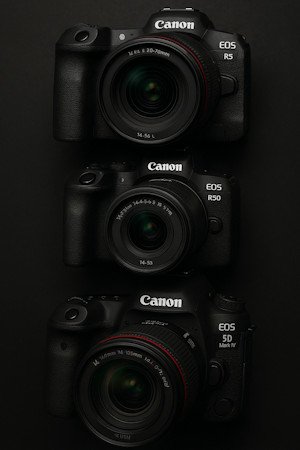
At the very top sits the EOS R1, Canon’s flagship sports and news machine. Built around a stacked sensor and some of the most robust weather-sealing the company has ever offered, it is the camera you reach for when nothing can go wrong. Just below it is the R5 Mark II, a 45-megapixel, 8K-capable body that has become the default choice for wedding photographers, landscape artists, and high-end videographers who need resolution to spare.

For photographers who want professional results without the $4,000-plus price tag, the R6 Mark III has emerged as the lineup’s most compelling argument. Its 32.5-megapixel full-frame sensor pairs with professional-grade video features in a body that feels genuinely balanced. It’s not a compromise, but a considered design choice.

Then there are the APS-C options, the R7 and R10, which deserve more credit than they typically get. The crop sensor on these cameras effectively extends the reach of any lens attached to them, making them ideal for wildlife and sports shooters who need a longer effective focal length. The R7 leads with top-tier speed, while the R10 offers a compact, budget-friendly entry point that still inherits the fast autofocus of its more expensive siblings.

The DSLR’s Quiet Persistence

Canon hasn’t released a new DSLR body in several years, and yet the category refuses to disappear. The reason is partly practical and partly philosophical. On the practical side, DSLR batteries last for days in a way that mirrorless bodies simply cannot match. On the philosophical side, an optical viewfinder gives you an unmediated window into the scene in front of you. It’s not a digital approximation of it, but actual light, passing through glass directly to your eye.

The EOS 90D remains the most versatile of the surviving DSLR lineup, pairing a high-resolution 32.5-megapixel sensor with ergonomics that feel immediately intuitive to anyone who has spent time with a Canon body. At the professional extreme, the EOS-1D X Mark III is virtually indestructible, and professionals who grew up shooting sports with a DSLR continue to reach for it, drawn by the mechanical satisfaction of the shutter and the zero-lag clarity of the optical view. For beginners, the Rebel SL3 makes a surprisingly strong case for itself as the smallest DSLR available, simple, light, and far more tactile than any smartphone.

What’s Shifting in 2026

Canon Cameras

Two trends are reshaping the Canon lineup this year. The first is deeper AI integration: modern EOS R cameras now use neural network processing not just for autofocus, but to upscale images in-camera and even anticipate subject movement before it happens. The second is a push toward content creators, exemplified by the “V” series of video-centric bodies like the R50 V, which adds improved microphones and better thermal management for extended recording sessions.

Perhaps the most intriguing development, though, is still a rumor. There is significant buzz around a retro-inspired Canon body, possibly called the RE-1, designed to evoke the classic AE-1 film cameras of the 1970s while running entirely modern internals. Whether it arrives or not, the fact that Canon is reportedly considering it says something interesting about where consumer appetite is right now.

So, Which Do You Choose?

The mirrorless EOS R system is the right choice if you want the best autofocus available, access to Canon’s growing RF lens catalog, and the confidence of seeing exactly what your sensor sees before you press the shutter. The DSLR is the right choice if the clarity of an optical viewfinder matters to you, if you want to stretch a budget further on the used market, or if you simply prefer a camera that doesn’t rely on a screen to show you the world. Neither answer is wrong. They just take you to very different places.

Filed Under: Photography

Build Your First Camera Bag on Any Budget

by Leave a Comment

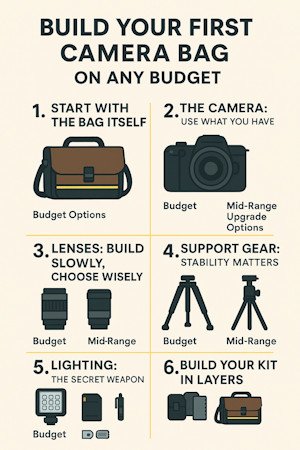
Putting together your first camera bag can feel intimidating. There’s an endless stream of gear videos, product reviews, and “must-have” lists that make it seem like you need thousands of dollars just to get started. The truth is much simpler: your camera bag should carry only what helps you make better photos. Nothing more. Whether you’re shooting with a smartphone, a beginner DSLR, or a mirrorless setup, the goal isn’t to own everything. It’s to build a small, flexible kit that grows naturally as your skills and interests develop.

Start With the Bag You Already Own

Your camera bag doesn’t need to be fancy or expensive. In fact, for many beginners, the best camera bag is the backpack already sitting in the closet. A simple padded insert can turn almost any bag into a perfectly functional camera carrier. Sling bags and compact shoulder bags also work well if you’re only carrying one camera and a lens or two.

Camera bag

As you shoot more, you’ll start to notice what works and what doesn’t. Maybe you want faster access to your camera, better weight distribution for long walks, or extra space for a laptop and tripod. That’s when upgrading to a dedicated camera backpack or sling can make sense. The right bag depends entirely on your shooting style. Street photographers tend to prefer slings for quick access, while hikers and travelers often lean toward backpacks for comfort and balance.

The Camera: Use What You Have

Your camera is the heart of your kit, but it doesn’t have to be expensive to be effective. Modern smartphones can produce incredible images, especially when paired with a small clamp tripod for stability. If you’re ready to step up, a used entry-level DSLR or mirrorless camera can be an excellent and affordable gateway into interchangeable lenses and full manual control. If you later decide to upgrade, current-generation APS-C mirrorless cameras offer outstanding quality, speed, and portability. Compact full-frame bodies can give you even more creative flexibility, but they’re far from necessary when you’re starting out. One of the smartest principles to follow is this: spend more on lenses than on camera bodies. Camera models change every few years, but good lenses can last decades.

Lenses: Let Them Shape How You See

It’s tempting to want a bag full of lenses, but more gear doesn’t automatically mean better photos. In fact, starting with just one or two lenses often leads to stronger skills and better results. Most photographers begin with the standard kit lens that comes with their camera, usually something like an 18–55mm or 16–50mm zoom. These lenses are far more capable than they’re given credit for. Adding an inexpensive 50mm f/1.8, often called the “nifty fifty”, opens the door to beautiful portraits, low-light photography, and creative background blur.As your interests become clearer, you may find yourself drawn to wider lenses for landscapes, telephoto zooms for wildlife or sports, or fast primes for artistic depth of field. But there’s no rush. Many photographers discover that a single prime lens teaches them more about composition, framing, and movement than a whole bag of zooms.

Stability Changes Everything

Sharp photos depend heavily on stability. Even the best camera struggles when your hands can’t hold still, especially in low light. A small tabletop tripod or affordable aluminum tripod can immediately improve sharpness, while a smartphone clamp opens up new possibilities for mobile shooting. If you do a lot of travel, hiking, or video work, a compact travel tripod or carbon-fiber model becomes worth considering. Video shooters may also benefit from small gimbals, which add smooth, cinematic movement. But even a simple, budget tripod can dramatically expand what you’re able to shoot.

Lighting: The Most Powerful Upgrade You Can Make

If there’s one upgrade that consistently transforms photography, it’s lighting. A tiny clip-on LED or small on-camera light can instantly improve portraits, product shots, and video quality. Reflectors, which cost very little, can shape natural light in beautiful ways. As your skills grow, adding a portable flash, wireless triggers, and simple softboxes or umbrellas gives you complete control over light, opening creative doors that no camera upgrade alone can match. Learning light changes everything.

The Small Essentials That Matter Most

Some of the most important items in your camera bag are also the cheapest. Extra batteries and memory cards prevent missed moments. A microfiber cloth keeps lenses clean. A rain cover or even a simple plastic bag can save your gear in bad weather. A power bank keeps everything running, and a small notebook can capture shot ideas, lighting setups, or location notes. These little details make the difference between frustration and smooth shooting.

Let Your Kit Grow Naturally

Think of your camera bag as something that evolves over time. At first, all you really need is a camera, one lens, a cleaning cloth, and a spare battery. From there, you might add a tripod, a small light, or a second lens. Eventually, your setup may expand into better bags, advanced lighting, and specialty lenses, but only when your photography demands it. Every piece of gear you add should solve a real problem or unlock a new creative possibility. If it doesn’t, it probably doesn’t belong in your bag.

Enjoy!

A great camera bag isn’t about owning the most equipment. It’s about having the right tools for the images you want to create. Start small. Upgrade slowly. Let your curiosity and creativity guide your choices. Over time, your bag will become a reflection of your unique photographic style, and every piece inside it will earn its place.

Filed Under: Photography

  • « Go to Previous Page
  • Page 1
  • Interim pages omitted …
  • Page 13
  • Page 14
  • Page 15
  • Page 16
  • Page 17
  • Interim pages omitted …
  • Page 31
  • Go to Next Page »

Primary Sidebar

Search TechVideos

Featured Headlines

Storytelling with Animation – Part 1 of 2

I lost My Watch – Animated Humor

Halloween Fun Party – A Muvizu Animated Comedy

Copyright © 2026 · Metro Pro on Genesis Framework · WordPress · Log in